Healthamu may earn a commission if you buy through links on this page, at no extra cost to you. That does not change what we report.
Part of our ProDentim overview. Last checked October 19, 2026.
Does ProDentim really work? Nobody can say yet, because ProDentim itself has never been tested in a published trial. What exists are small studies of related probiotic strains, and those show modest gum effects, mostly in people who also had a professional dental cleaning. A 2024 review of 11 L. reuteri trials called the evidence "limited", with bias concerns in all 11.[6]
Does ProDentim work? The short answer
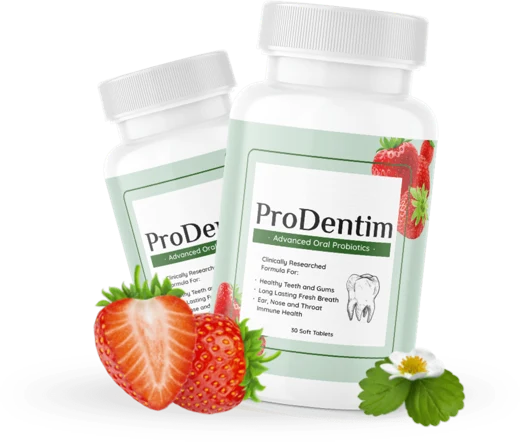
Short answer: unproven. ProDentim has no published trial, so there is no data on what this strawberry soft tablet does for gums, breath or cavities. The vendor says its blend is "backed by clinical research",[2] but that research tested single strains in other forms and doses.
What you can reasonably conclude: three of the four bacteria on the label (L. reuteri, B. lactis and S. salivarius) have small randomized trials with some gum or plaque benefit. Only one strain on the label carries a code, BL-04, and we found no oral-health trial of BL-04.[1]
What you cannot conclude: that a 20 mg blend with a hidden split, taken once or twice a day, repeats those results. NCCIH says probiotic effects are strain-specific, so one strain's result does not transfer to another.[7] Our review method explains how we grade this kind of gap.
Which evidence levels should you not confuse?
Four levels of evidence get blended together on supplement pages. Only the last two can tell you whether a product works, and ProDentim has neither of those for the finished tablet.
Plausibility
Mouth bacteria shape plaque and gum inflammation, so adding helpful bacteria is a fair idea to test. An idea is the weakest level of evidence, and most of the ProDentim sales page sits here.
Ingredient trials
Trials of named strains, such as L. reuteri DSM 17938 with ATCC PTA 5289, or B. lactis HN019, come next. They show what that strain did, at that dose, in that group of people. Most used lozenges twice a day at roughly 100 million to 1 billion CFU per strain.[4][5]
Finished-product trial
A randomized, placebo-controlled trial of ProDentim tablets would answer the question directly. None is published. The vendor's references page lists 17 titles, including one about K12, a strain the label never names.[3]
Replication
Strain results also need repeating by independent teams. For L. reuteri, a 10-trial gingivitis meta-analysis found no significant pooled effect on gum or plaque index.[8] One S. salivarius M18 trial in children was run by staff of the strain's maker.[9]
ProDentim claims vs what the evidence supports
The sales claims go further than the studies behind them. This table sets each main vendor claim beside what trials actually measured.
| Vendor claim | Reasonable reading | Limitation |
|---|---|---|
| Blend "backed by clinical research" | Some strains in the blend have small trials | No ProDentim trial; 3 of 4 bacteria have no strain code on the label |
| Supports teeth and gums | HN019 and L. reuteri lozenges improved pocket depth when added to scaling and root planing[4][5] | Benefit came on top of professional cleaning, at coded strains and stated doses |
| Fresher breath | S. salivarius K12 is the strain usually tested for breath | K12 did no better than placebo between groups in a 30-day trial[10] |
| Malic acid "helps maintain tooth whiteness" | A 1% malic acid spray helped dry mouth in trials[11] | Malic acid is not on the label; no whitening trial exists |
| Results in 9 to 12 weeks (vendor FAQ) | No source given[12] | Strain trials ran 4 to 12 weeks, with lozenges |
The full label breakdown, ingredient by ingredient, is on our ProDentim ingredients list page.
Which ingredients matter most?
The four bacteria matter most, and each one differs from the studies in strain, dose or form. The label gives 3.5 billion CFU at manufacture for the three-strain blend, with no split and no guarantee through the expiry date.[1]
- L. reuteri: trials used at least 100 million CFU of each of two coded strains per lozenge, two lozenges a day, for 7 to 12 weeks.[5][13] ProDentim gives no strain code.
- B. lactis: gum trials used HN019, about 1 billion CFU twice daily.[4] ProDentim lists BL-04, which has no oral trial we could find.
- S. salivarius: K12 and M18 lozenges of about 1 billion CFU were tested. The label lists 20 mg with no CFU and no strain code.[1]
- L. paracasei: the positive trials gave strain SD1 in milk to young children. Adults taking GMNL-33 tablets did no better than placebo.[14]
The people differ too. Many gum trials enrolled adults with diagnosed periodontitis who also had a deep cleaning. The 100 mg of inulin has no oral-health trial at all.
What results are realistic to expect?
If ProDentim acted like the better-studied strains, the ceiling would be a small drop in gum bleeding or plaque over 4 to 12 weeks. That is an assumption, since the product is untested. Here is what the strain trials measured:
- B. lactis HN019, 8 weeks: less gum bleeding than placebo in people with gingivitis.[15]
- S. salivarius M18, 4 weeks: lower gingival index in young adults with gingivitis.[16]
- L. reuteri, 12 weeks after full-mouth disinfection: more pocket reduction in moderate and deep pockets.[5]
No trial measured whiter teeth, stronger enamel or less sinus trouble. Buyer reports are collected in ProDentim reviews and complaints.
When should you see a doctor instead?
Gum and tooth problems that are getting worse need a dentist, and some need care the same day. A supplement trial can delay that. See a doctor or dentist right away if you have:
- Swelling in the face, jaw or neck, or fever with mouth pain
- Gums that bleed heavily or will not stop bleeding
- A loose adult tooth or pus near a tooth
- Severe tooth pain that wakes you or does not ease
- A mouth sore, lump, or white or red patch that does not heal
- Bad breath that stays despite brushing, flossing and cleaning your tongue
Safety cautions for the tablet itself are on our ProDentim side effects page.
Evidence conclusion
ProDentim is a plausible idea with weak backing for the exact product. The table sums up where the evidence stood on October 19, 2026.
| Decision question | Current assessment |
|---|---|
| Has ProDentim itself been tested? | No published trial |
| Do its bacteria have oral-health evidence? | Limited: small trials, mostly as an add-on to cleaning[17] |
| Is the dose comparable to the trials? | Unknown, because the blend split is hidden |
| Does the sales page match the label? | No: malic acid is missing from the label, S. salivarius is missing from the page |
| Can it replace brushing, flossing or dental visits? | No trial supports that |
If you still want to try it, the vendor offers a 60-day refund, and you return every bottle at your own cost (checked October 19, 2026). Whether the seller is trustworthy is covered in is ProDentim legit.
Back to the ProDentim overview.
Frequently asked questions
Is ProDentim effective for gums?
Nobody knows for this exact product, because ProDentim has no published trial. Related strains such as B. lactis HN019 and L. reuteri reduced gum bleeding or pocket depth in small trials, mostly when people also had a professional cleaning.
Does ProDentim really work for bad breath?
There is no proof it does. S. salivarius K12, the strain usually tested for breath, did no better than placebo between groups in a 30-day trial, and the ProDentim label does not say which S. salivarius strain it contains.
How long does ProDentim take to work?
The vendor FAQ says 9 to 12 weeks but gives no source. Strain trials measured gum changes after 4 to 12 weeks of lozenges. ProDentim has no data, and its refund window is only 60 days.
Does ProDentim really work for dogs?
ProDentim's label gives directions for people only, and none of the trials we reviewed tested dogs. Ask a veterinarian before giving a human supplement to a pet, since peppermint oil and the flavoring were not studied in animals.
What does ProDentim do?
The vendor says ProDentim adds helpful bacteria to the mouth to support teeth and gums. The label lists 3.5 billion CFU of three bacteria plus S. salivarius and inulin. What the finished tablet does has not been tested.
Sources
- ProDentim Supplement Facts label (image). ProDentim, read October 19, 2026.
- ProDentim text presentation (sales page). ProDentim, read October 19, 2026.
- ProDentim references page. ProDentim, read October 19, 2026.
- Invernici et al. 2018, B. lactis HN019 as an adjunct to scaling and root planing in chronic periodontitis. PubMed, National Library of Medicine, read October 19, 2026.
- Teughels et al. 2013, L. reuteri lozenges after full-mouth disinfection in chronic periodontitis. PubMed, National Library of Medicine, read October 19, 2026.
- Ram et al. 2024, systematic review of L. reuteri in periodontitis (11 RCTs). PubMed, National Library of Medicine, read October 19, 2026.
- Probiotics: What You Need To Know. National Center for Complementary and Integrative Health (NCCIH), read October 19, 2026.
- Akram et al. 2020, meta-analysis of probiotics in gingivitis. PubMed, National Library of Medicine, read October 19, 2026.
- Burton et al. 2013, S. salivarius M18 in caries-active children. PubMed, National Library of Medicine, read October 19, 2026.
- He et al. 2020, S. salivarius K12 in tongue-coating halitosis. PubMed, National Library of Medicine, read October 19, 2026.
- Liu et al. 2023, meta-analysis of 1% malic acid spray for dry mouth. PubMed, National Library of Medicine, read October 19, 2026.
- ProDentim contact page and FAQ. ProDentim, read October 19, 2026.
- Schlagenhauf et al. 2016, L. reuteri lozenges and pregnancy gingivitis. PubMed, National Library of Medicine, read October 19, 2026.
- Chuang et al. 2011, L. paracasei GMNL-33 tablets and oral bacteria in adults. PubMed, National Library of Medicine, read October 19, 2026.
- Furlaneto et al. 2024, B. lactis HN019 in gingivitis. PubMed, National Library of Medicine, read October 19, 2026.
- Babina et al. 2023, S. salivarius M18 in young adults with gingivitis. PubMed, National Library of Medicine, read October 19, 2026.
- Meta-analysis of probiotics as an adjunct in gingivitis and periodontitis (24 studies). PubMed, National Library of Medicine, read October 19, 2026.

Lucie reads the full supplement label, sets each dose beside the amounts used in human studies, and works out the real cost per day and the refund terms before a review goes live. Lucie is not a doctor, dietitian or pharmacist. How we review supplements.
This page is general information, not medical advice. Dietary supplements are not reviewed by the FDA for safety or effectiveness before they are sold and are not intended to diagnose, treat, cure or prevent any disease. Talk to your doctor before taking any supplement, especially if you are pregnant, nursing, take medication or have a health condition.