Healthamu may earn a commission if you buy through links on this page, at no extra cost to you. That does not change what we report.
Part of our ProDentim overview. Last checked October 19, 2026.
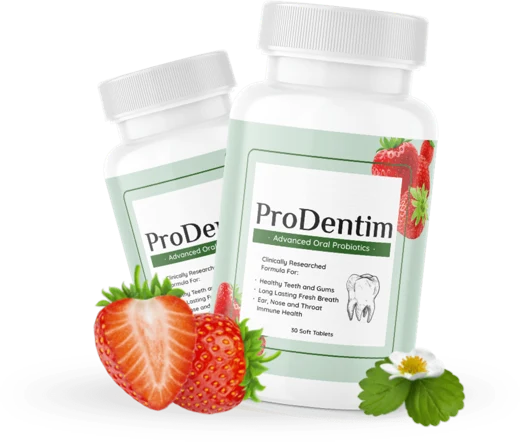
The ProDentim ingredients list on the vendor's own label has four active entries: 100 mg of inulin, a 20 mg proprietary blend of three bacteria, and 20 mg of Streptococcus salivarius.[1] The blend holds 3.5 billion CFU at the time of manufacture, with no split between strains. Four other ingredients have no stated amount, and malic acid, which the sales page promotes, does not appear on the label at all.[2]
ProDentim ingredients at a glance
Only two entries on the label have a known amount per strain or ingredient: inulin and S. salivarius. The table lists everything on the label, plus malic acid from the sales page, with the evidence grade from our ingredient files.
| Ingredient | Role claimed | Amount disclosed? | Evidence grade |
|---|---|---|---|
| Inulin (chicory root) | Prebiotic fiber | Yes, 100 mg | Weak |
| Lactobacillus paracasei | Oral probiotic | No, inside 20 mg blend | Limited |
| Lactobacillus reuteri | Oral probiotic | No, inside 20 mg blend | Limited |
| Bifidobacterium lactis BL-04 | Oral probiotic | No, inside 20 mg blend | Limited (no BL-04 oral trial) |
| Streptococcus salivarius | Not mentioned on sales page | 20 mg, CFU not stated | Limited |
| Tricalcium phosphate | "Minerals" (sales page) | No | Weak |
| Peppermint essential oil | "Natural anti-inflammatory" (vendor) | No | Weak |
| Microcrystalline cellulose, natural strawberry flavor | Tablet base and taste | No | Not graded |
| Malic acid | Tooth whiteness (vendor) | Not on the label | Weak as a chewable ingredient |
What is in each ingredient, and what does research say?
Every ingredient below has human research of some kind, but none was tested inside ProDentim. The doses and forms studied mostly differ from the label.
Inulin (chicory root), 100 mg
Inulin is a plant fiber that gut bacteria feed on. Fiber trials dose it in grams, so 100 mg is a small fraction of studied amounts. A meta-analysis of 33 trials found inulin-type fiber did not change body weight,[3] and we found no oral-health trial. Its prebiotic role in the mouth is untested.
Lactobacillus paracasei
Strain SD1, given in milk once a day for 3 months, lowered S. mutans and new cavities in young Thai children.[4] Adults who took GMNL-33 tablets three times a day for 2 weeks did no better than placebo.[5] ProDentim gives no strain code, so neither result transfers. Grade: limited.
Lactobacillus reuteri
This is the most-studied oral probiotic. Two coded strains, at least 100 million CFU each per lozenge, twice a day, gave more pocket reduction after a deep cleaning in a 30-person trial.[6] A review of 11 trials still called the evidence limited.[7] Grade: limited.
Bifidobacterium lactis BL-04
Gum trials used a different strain, HN019, at about 1 billion CFU twice daily. Added to scaling and root planing, it improved pocket depth and attachment at 90 days.[8] We found no oral-health trial of BL-04, the only strain code on the ProDentim label. Grade: limited.
Streptococcus salivarius, 20 mg
Strains K12 and M18 are native to the mouth and were tested as 1 billion CFU lozenges. M18 lowered the gingival index in young adults over 4 weeks.[9] K12 did no better than placebo between groups for bad breath.[10] The label names no strain and no CFU. Grade: limited.
Tricalcium phosphate
This calcium salt is common in tablets as an anti-caking and flow agent. We found no trial of swallowed tricalcium phosphate for enamel. The only dental study used it inside a fluoride varnish, where fluoride drove the effect.[11] Grade: weak.
Peppermint essential oil
Mint rinses combined with zinc or chlorhexidine reduced breath odor for 12 hours,[12] but no trial tested peppermint alone. NCCIH says there is not enough evidence that peppermint helps any condition.[13] Here it works as a flavor. Grade: weak.
Malic acid (sales page only)
A 1% malic acid spray improved dry mouth in 5 trials with 244 people.[14] That was a spray, not a chewable, and malic acid is missing from the ProDentim label. Grade: weak as a chewable ingredient.
How transparent is the ProDentim formula?
Partly. The vendor publishes a full Supplement Facts label, which many supplements do not, but the 20 mg blend hides how the 3.5 billion CFU are split among three bacteria.[1] An even split would be about 1.2 billion each, yet the label does not say the split is even.
The label and sales page also disagree. The sales page calls the product "3 scientifically proven strains" while the label lists four bacteria, and it promotes malic acid that the label leaves out.[2] The references page cites K12 and dicalcium phosphate, neither of which the label names.[15]
Third-party sites often copy the sales page, so their lists vary. Trust the label on the bottle you receive. Ours was read on October 19, 2026.
The label also carries "GMP Certified" and "Manufactured in a FDA Registered Facility" badges. Registration means the facility is listed with the FDA. It is not an FDA review of the formula, and the manufacturer is not named.
Ingredient safety and interactions
At these amounts, the main cautions come from the probiotics. NCCIH reports rare serious infections from probiotics in premature infants and in people who are severely ill or immunocompromised.[17] Antibiotics taken at the same time may kill the bacteria.
Peppermint oil taken by mouth can cause heartburn or nausea in some people, and inulin can cause gas at higher intakes. Calcium can reduce absorption of some antibiotics and thyroid medicine, though the excipient amount here is likely tiny.[16] Full details are on our ProDentim side effects page, and timing tips are in how to take ProDentim.
Do these ingredients prove ProDentim works?
No. Ingredient trials show what a coded strain did at a known dose, usually as a lozenge and often after a professional cleaning. ProDentim combines different or uncoded strains at an undisclosed split, and the finished tablet has no published trial.
Our does ProDentim really work page weighs the claims against the trials. Price and refund terms are on ProDentim price, checked October 19, 2026.
Back to the ProDentim overview.
Frequently asked questions
What strains are in ProDentim?
The label lists Lactobacillus paracasei, Lactobacillus reuteri and Bifidobacterium lactis BL-04 in a 20 mg blend, plus 20 mg Streptococcus salivarius. Only BL-04 has a strain code, and the split of the 3.5 billion CFU is not disclosed.
Does ProDentim contain malic acid?
Not according to the label. The sales page says malic acid helps keep teeth white, but the Supplement Facts label read on October 19, 2026 does not list it among active or other ingredients. Trust the label on your bottle.
How many CFU are in ProDentim?
The label states 3.5 billion CFU at the time of manufacture for the three-strain blend. That count is not guaranteed through the expiry date, and the label gives no CFU figure for the 20 mg of S. salivarius.
Is ProDentim vegan?
The Supplement Facts label does not state whether ProDentim is vegan. If this matters to you, email the vendor at contact@prodentim-product.com before buying and ask how the bacteria are grown and what the flavor contains.
Where do ProDentim ingredients come from?
The label names ProDentim of Tallmadge, Ohio, as distributor but does not name the manufacturer or ingredient suppliers. Inulin comes from chicory root, according to the label. Strain sources are not disclosed.
Sources
- ProDentim Supplement Facts label (image). ProDentim, read October 19, 2026.
- ProDentim text presentation (sales page). ProDentim, read October 19, 2026.
- Meta-analysis of 33 RCTs on inulin-type fructans and body weight. PubMed, National Library of Medicine, read October 19, 2026.
- Pahumunto et al. 2018, L. paracasei SD1 milk and caries in young children. PubMed, National Library of Medicine, read October 19, 2026.
- Chuang et al. 2011, L. paracasei GMNL-33 tablets and oral bacteria in adults. PubMed, National Library of Medicine, read October 19, 2026.
- Teughels et al. 2013, L. reuteri lozenges after full-mouth disinfection in chronic periodontitis. PubMed, National Library of Medicine, read October 19, 2026.
- Ram et al. 2024, systematic review of L. reuteri in periodontitis (11 RCTs). PubMed, National Library of Medicine, read October 19, 2026.
- Invernici et al. 2018, B. lactis HN019 as an adjunct to scaling and root planing. PubMed, National Library of Medicine, read October 19, 2026.
- Babina et al. 2023, S. salivarius M18 in young adults with gingivitis. PubMed, National Library of Medicine, read October 19, 2026.
- He et al. 2020, S. salivarius K12 in tongue-coating halitosis. PubMed, National Library of Medicine, read October 19, 2026.
- Chen et al. 2021, fluoride varnish with functionalized TCP in toddlers. PubMed, National Library of Medicine, read October 19, 2026.
- Erovic Ademovski et al. 2016, mouthrinses with mint, zinc and chlorhexidine for halitosis. PubMed, National Library of Medicine, read October 19, 2026.
- Peppermint Oil. National Center for Complementary and Integrative Health (NCCIH), read October 19, 2026.
- Liu et al. 2023, meta-analysis of 1% malic acid spray for dry mouth. PubMed, National Library of Medicine, read October 19, 2026.
- ProDentim references page. ProDentim, read October 19, 2026.
- Calcium: Fact Sheet for Health Professionals. NIH Office of Dietary Supplements, read October 19, 2026.
- Probiotics: What You Need To Know. National Center for Complementary and Integrative Health (NCCIH), read October 19, 2026.

Lucie reads the full supplement label, sets each dose beside the amounts used in human studies, and works out the real cost per day and the refund terms before a review goes live. Lucie is not a doctor, dietitian or pharmacist. How we review supplements.
This page is general information, not medical advice. Dietary supplements are not reviewed by the FDA for safety or effectiveness before they are sold and are not intended to diagnose, treat, cure or prevent any disease. Talk to your doctor before taking any supplement, especially if you are pregnant, nursing, take medication or have a health condition.